For 25 months, SATX.gay kept a running record of LGBTQ+ public life in San Antonio. Not a highlight reel — a census. Every drag show, support group, book club, worship service and vigil we could verify, counted every time it happened.
Across the full window — June 2024 through June 2026 — that comes to an estimated 7,497 event occurrences. They span 506 venues and 57 ZIP codes.
We built it to answer a question nobody in this city had a real answer to. Where does queer San Antonio actually happen? And who does it leave out?
A community with a center of gravity
More than half of everything — 54.6% — happened inside a single ZIP code. That’s 78212: The Strip on Main Avenue, running up through Tobin Hill toward Monte Vista, with 3,561 logged events. Add downtown (78205), Beacon Hill (78201) and the Midtown-Pearl corridor (78215), and four ZIP codes hold 81.8% of everything. Four ZIP codes, out of 57.
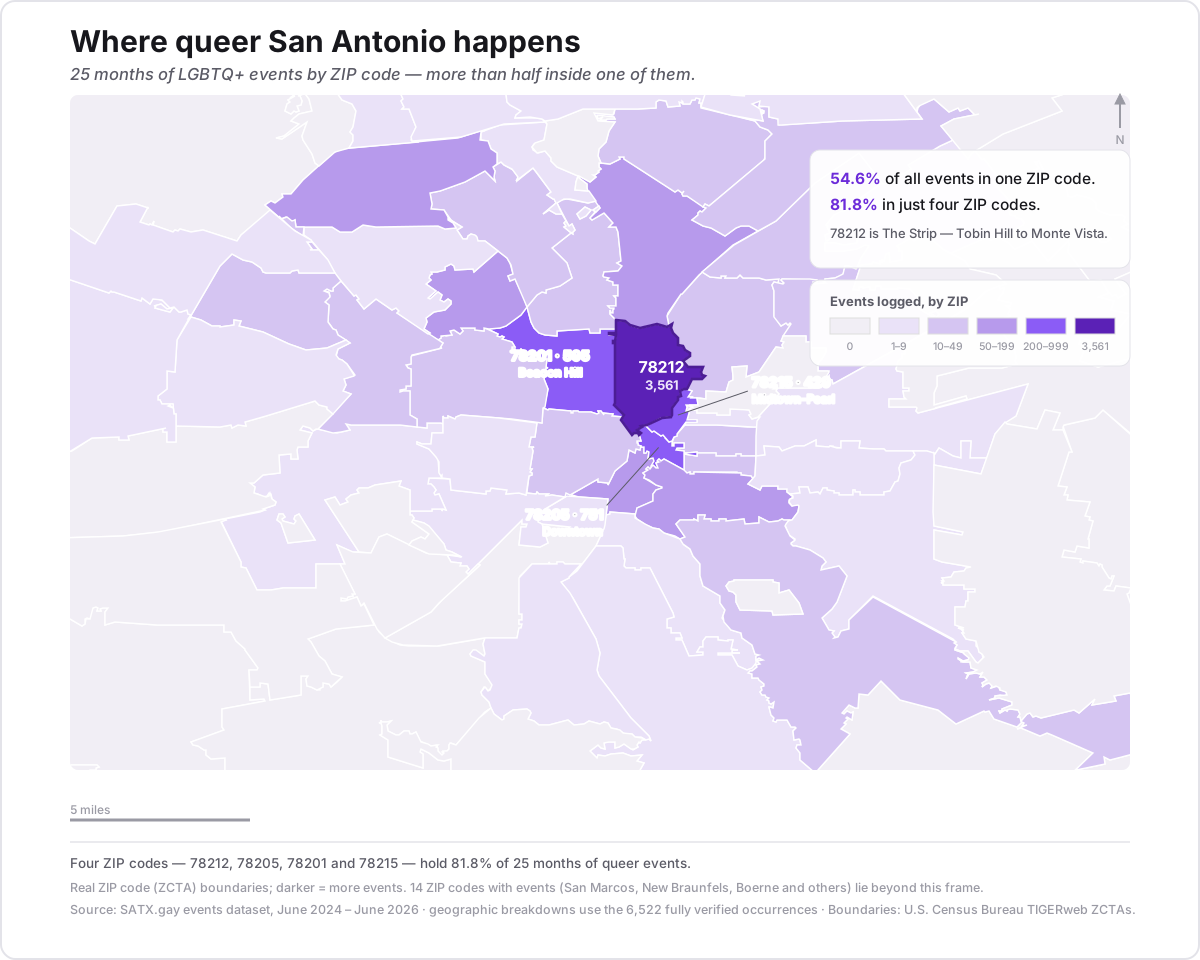
That’s not an accident of measurement. It’s the physical legacy of a scene built around a small cluster of bars that have anchored queer San Antonio for decades — because for a long time, bars were the only rooms that would have us.
What we build when we gather
Number one, and it isn’t close — drag, with 1,509 occurrences, nearly a quarter of everything. Then nightlife and dance parties, then the quieter machinery of community: meetings, potlucks, support circles.
But the most telling number is rhythm: 71.1% of all events are part of a recurring series — 309 named, repeating programs. This community isn’t built on festivals; it’s built on standing appointments. Somebody’s Tuesday bingo. A support group that’s met for years.
Saturday is the busiest night (1,395 events), Tuesday the quietest (376), and June is real. Against a typical month of about 292 events, June 2024 hit 495 and June 2025 hit 446 — Pride season runs about one and a half times a normal month.
Bars and nightclubs still host about 69% of it all — but community centers, libraries, parks and faith spaces now carry roughly one event in six. The scene is slowly growing beyond last call.
The gap
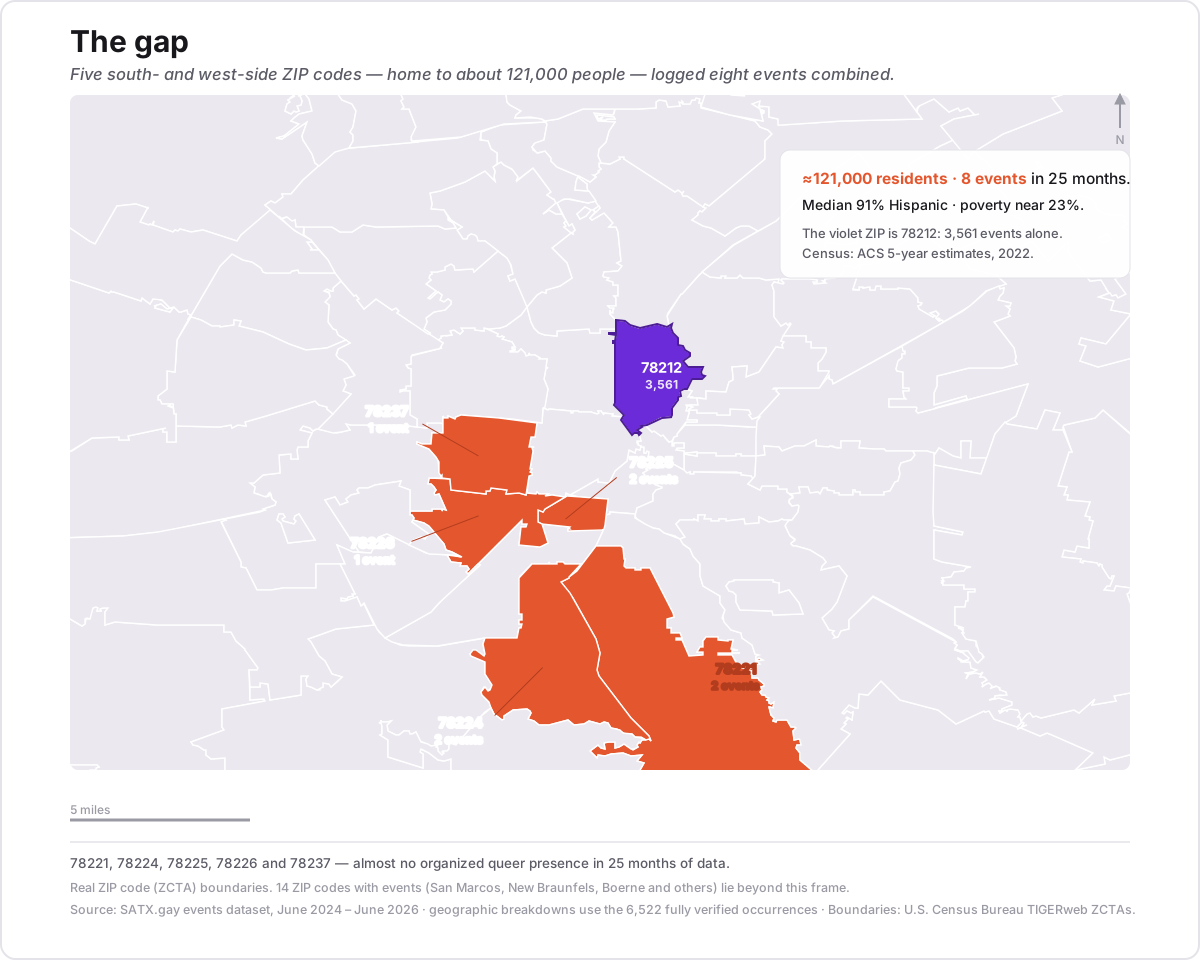
Five ZIP codes on the south and west sides tell a different story.
| ZIP | Events (25 mo) | Population | Median income | Hispanic | Poverty |
|---|---|---|---|---|---|
| 78221 | 2 | 40,272 | $57,209 | 88.8% | 18.3% |
| 78237 | 1 | 38,492 | $38,447 | 95.2% | 28.6% |
| 78224 | 2 | 20,965 | $53,841 | 90.6% | 17.7% |
| 78225 | 2 | 13,802 | $43,883 | 93.1% | 23.0% |
| 78226 | 1 | 7,357 | $30,669 | 90.5% | 30.7% |
Census figures: ACS 5-year estimates, 2022 vintage.
Roughly 121,000 people. The typical ZIP code among them is 91% Hispanic, with poverty near 23%. Eight LGBTQ+ events between them, total. One ZIP code on the near-north side had 3,561.
To be precise about what this is and isn’t, 20 ZIP codes logged fewer than five events, but most of that population lives in affluent far-north suburbs that were simply never where this scene was built. These five neighborhoods are different — lower-income, overwhelmingly Hispanic and, in our records, with almost no organized queer presence at all. By region, the far South Side logged two events in the entire window. The Southwest, four. The near East Side, eleven.
That’s not a scene-geography quirk. That’s a gap — the parts of San Antonio where, as far as our records show, queer people have almost no venue, no standing meeting and no room in their own ZIP code.
How we counted
Every event began as a listing published on SATX.gay — found by monitoring venue and organizer accounts plus direct submissions, with a human reviewing every entry before it counts. Roughly a third of what a queer-friendly venue posts isn’t actually an LGBTQ+ event — that call takes a person.
The accounting counts occurrences, not listings. So a weekly drag night that ran 40 times counts 40 times, not once. Where our records kept recurring events as a single series, we expanded each schedule back into its individual dates so every gathering is counted every time it happened.
About 8% of events couldn’t be confidently categorized, about 4% lack a precise location and our record begins in June 2024 — nothing earlier is included.
The map is a starting point
A dataset is a form of memory. It’s also evidence: “we deserve investment” is an argument; 7,500 events — and five neighborhoods of 121,000 people with almost none — is information queer leaders can use to advocate for expanded services and events in those areas.
If you organize LGBTQ+ events in San Antonio — especially on the south or west sides — submit your events. The map has holes. Some are gaps in service. Some are just gaps in what we can see. Help us learn which is which.